
Working in the round is easier than you might think
You might have noticed that I quite like working in the round. I'm not a huge fan of seaming (although I've warmed to the idea in some applications).
I've experimented with a few different ways of working in the round. I started off by learning how to work in a spiral with a double ended hook. This is a wonderful method for making beanies and cowls. It's not so good if you are working in stripes, mosaic or a stitch pattern that will look weird in a spiral.
This is where a cabled hook comes in. There are quite a few ways of using that cable to work in the round. You may have come across tutorials on the 'magic loop method' - this is the first way I learned and if I'm honest, I can't remember how to do it. It's kinda clunky!
A few years back, I used a method pioneered by my friend Rachel Henri. She invented a connecting stitch that works really well and I've used it to make one of her amazing jumper patterns. This method leaves a little jog that just wasn't working for me on Tunisian Crochet mosaic.
It was actually one of my pattern testers that told me about Ben Burchall. His video for this method seems to have vanished, but it was his video demonstration that taught me how to do it.
You still work in rows with a forward and return pass. You even pick up the edge stitch. Once you've picked up all the loops in the round, you bring the start of the round up to the hook tip using the cable to help you do it.
The video and images below should give you the tools you need to learn this method. Just remember that practice makes perfect; don't give up if it's wonky for the first few times
How to work in the round with a cabled hook
You'll see loads of my patterns referring to a 'connecting stitch'. This term is demonstrated in full in this video and written in words below. You need a single ended hook with a cable attached that has a stopper at the end.
Step 1: Work all the sts required for a FP, including the edge st of the row.
Step 2: Keep between 1/3 to 1/2 sts on the hook and move the remainder to the cable.
Step 3: Bring the 1st st of the Round up to the hook tip. Ensure the row of sts is not twisted.
Step 4 (connecting st): Insert the hook into the first two loops of the Round with the hook exiting the back of the work (like tks2tog). Yarn over and draw the yarn through those two loops (these are the first 2 sts of the row).
Step 5 (RP): Complete the RP yarn over, pull through 2 loops until 1 loops remains.
Patterns made using this method
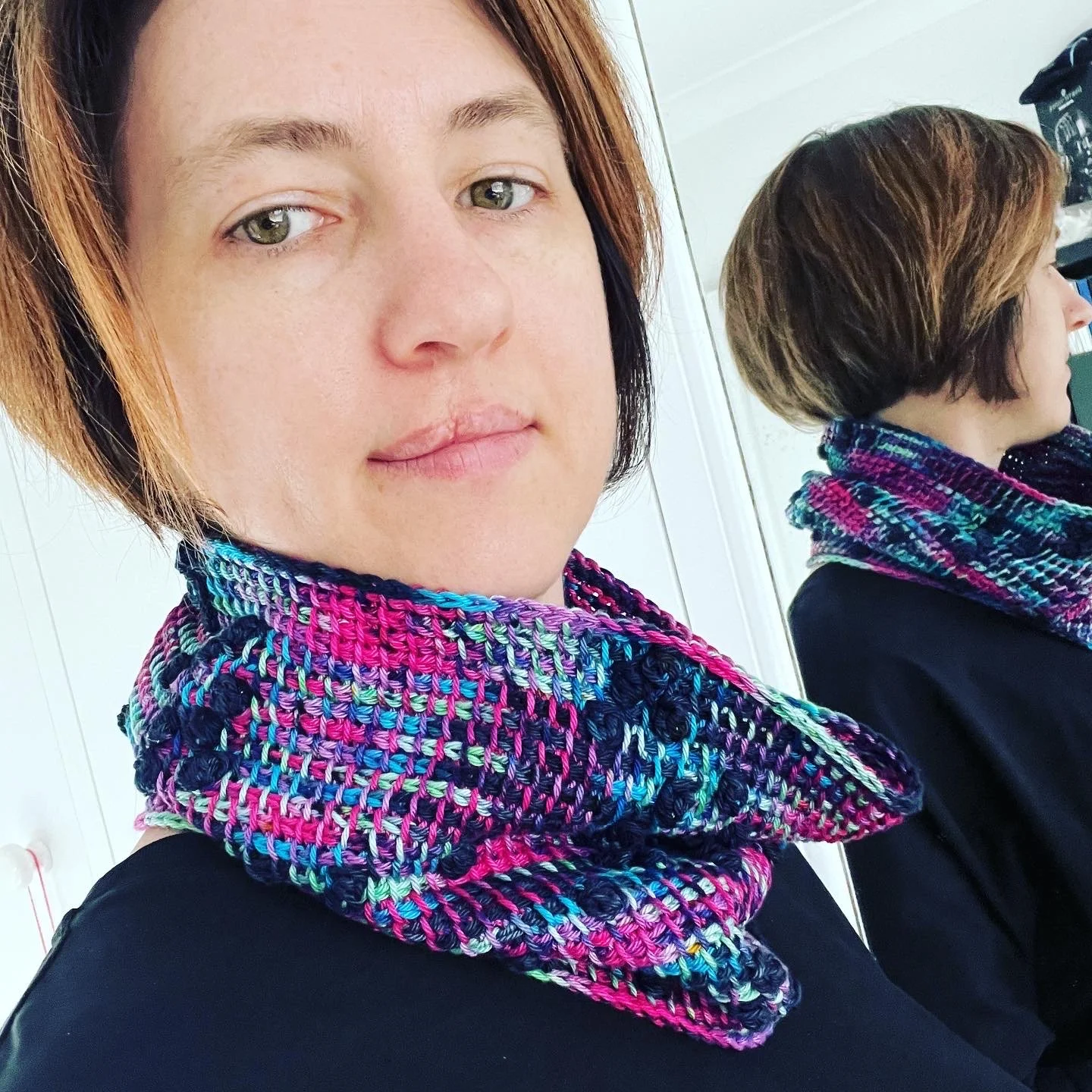
This product is an eBook containing four Tunisian crochet cowl patterns.
For those wanting to stretch their skills past Tunisian simple stitch and make something wearable and lovely. Choose a skein of yarn that has colour pops - either multiple colours per skein or a colour pop skein (with one small contrasting section) and make a bobble every time you reach your assigned colour!
Four beginner friendly patterns available in this ebook starting with the easiest and working your way up the skill levels.
These cowls are quick makes and are great for gifting.
Skills needed
Tunisian Crochet Foundation row
Tunisian Simple Stitch
Simple bind off
You will learn through the eBook
How to adjust the patterns for different gauges (different yarn weights)
How to adjust size using gauge
How to work in the round with a simple connecting stitch and a cabled hook (technically working in rows with a join at the end)
How to make bobbles
How to do simple decreases
How to increase using the back bump of the return pass chain
An unconventional construction method
Yarn requirements
You need to use variegated yarn. You can use assigned colour pooling yarn or colour popped yarn (a section of contrasting colour in your skein).
Hook
A cabled hook is required.
All samples were made in 5.5mm aluminium @Catch_hooks hook with a Chiagoo cable.
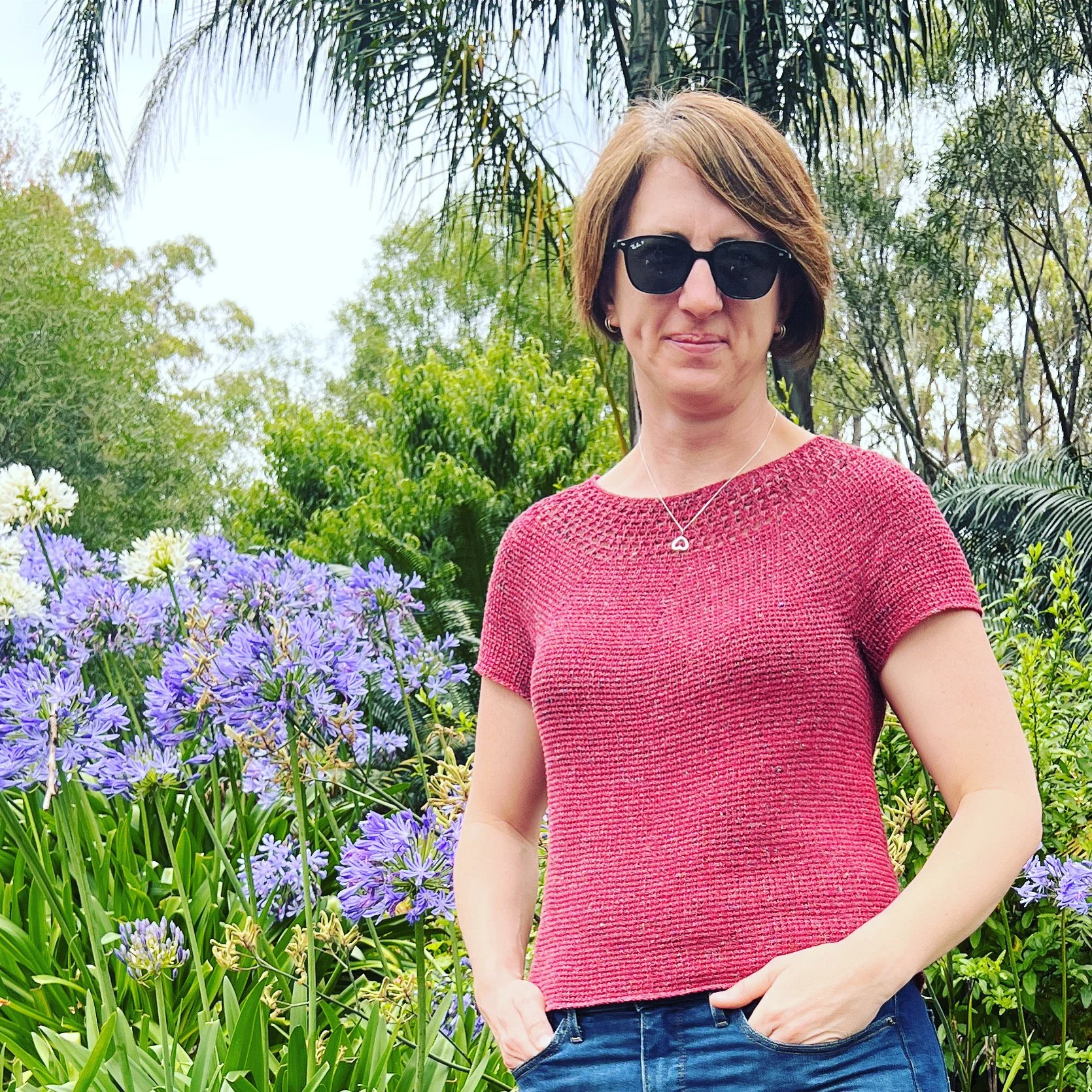
The Enid Tee is named after my 93 year old grandmother, Enid Ruby. Of course it’s not just her name but also the ruby colour of this fabulous yarn! This is a classic, unfussy tee that can be styled up or down depending on the occasion. The addition of a pretty lace yoke gives interest to an otherwise straightforward top-down make.
Enid Tee is worked top down using a cabled Tunisian crochet hook. Rounds are joined with a connecting stitch which means there are no seams to join. The Tee is planned for summer yarns like cottons and linen but can be made in any fibre once a consistent gauge is met.
Sizes & Measurements
All measurements are to the nearest .5cm / .25in. Measurements are calculated using gauge: not all figures convert exactly between cm and in for this reason.
a) Neck circumference: 55.5 (61.5, 61.5, 68, 68)(74, 74, 80, 80, 86)cm / 22.25 (24.75, 24.75, 27, 27)(29.5, 29.5, 32, 32, 34.5)in
b) Yoke depth: 17 (19, 21, 21, 22.5)(24.5, 24.5, 26, 27, 27)cm / 6.75 (7.5, 8.5, 8.5, 9)(10, 10, 10.25, 10.75, 10.75)in
c) Bust circumference: 85.5 (98.5, 110.5, 123, 129)(146, 153, 162, 169, 181.5)cm / 34.25 (39.25, 44.25, 49, 51.5)(58.5, 61, 65, 67.5, 72.75)in
d) Body length from underarm: 29 (29.5, 30, 30, 30)(30.5, 30.5, 31, 31, 31.5)cm / 11.5 (11.75, 12, 12, 12)(12.25, 12.25, 12.5, 12.5, 12.75)in
e) Upper arm circumference: 31.5 (32, 34.5, 36, 42)(44.5, 48, 52, 56, 63.5)cm / 12.75 (13, 13.75, 14.5, 17)(17.75, 19, 21, 22.5, 25.25)in
f) Sleeve length from underarm: 3cm / 1.25in
Supplies
5mm hook interchangeable crochet hook with detachable cable at least 60cm/24in long (adjust hook size to meet gauge)
Up to 4 markers
Darning needle
Yarn
Fingering/Australian 4 ply yarn recommended in a non-stretch fibre such as cotton, linen or silk.
Sample is size 3 and used Queensland Collection, Dungarees Rainbow Tweed (fingering/size 1/superfine, 100g/459y/420m). This yarn is 76% recycled cotton (denim), 7% recycled polyester, 5% polyamide.
Yarn quantity
Grams: 170 (195, 220, 245, 270)(295, 320, 345, 370, 395)
Meters: 714 (819, 924, 1029, 1134)(1239, 1344, 1449, 1554, 1659)
Yards: 780 (895, 1010, 1125, 1239)(1354, 1469, 1584, 1698, 1813)
Gauge
18 tss x 19 rows = 10cm/4in x 10cm/4in.
Tech editing by Anita Reinehr aka knotart
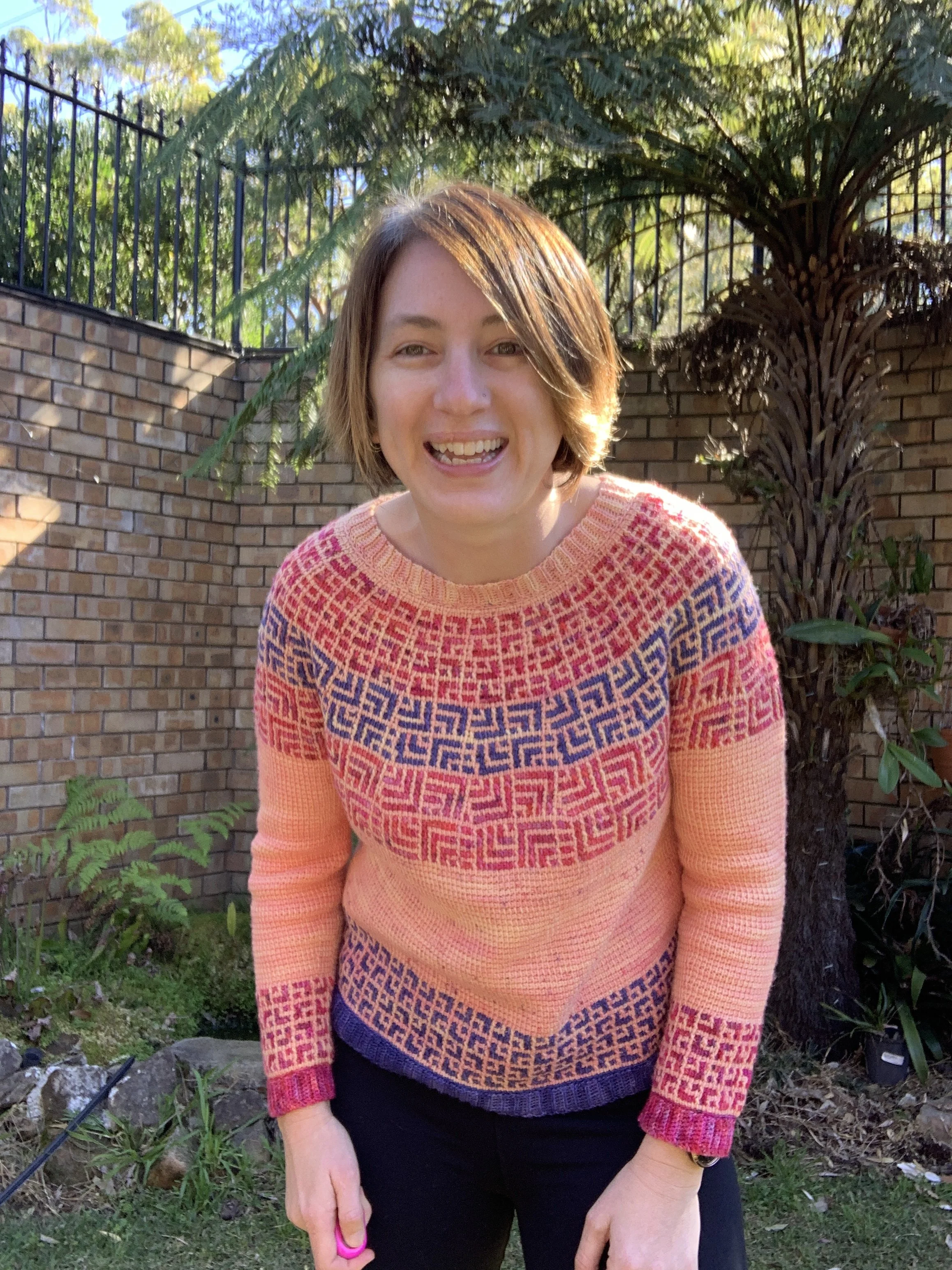
The Tesserae Jumper is a top down jumper worked in the round in Tunisian Crochet. A geometric mosaic pattern is worked around the yoke, the base of the torso and the base of the sleeves. All the cuffs on the jumper are made in standard crochet. The fit of the jumper is customisable with steps in the pattern included for how to do this.
Sizes
14 sizes available - women’s XS to 5XL and men’s S-2XL. See the attached chart image for the planned measurements of this jumper (blocked measurements). Positive ease is planned between 10cm/4” - 15cm/6”.
Yarn
Fingering weight yarn in at least 2 colours. Aim for yarn with a meterage of 400m per 100g. You will need a main colour and at least one contrast colour. If using variegated yarn, keep it subtle as a busy yarn will hide the mosaic pattern. Semi solids and tonals are highly recommended.
See the attached chart image for meterage required per size. Adding to the planned length will require more yarn.
Hooks
A cabled tunisian hook for working in the round on all tunisian portions - I used a 5.5mm hook. Testers ranged between 4.5mm and 6mm hooks. It is very important to make a gauge swatch, block, dry and measure accurately before choosing your hook for the project. Pointy hooks will be easier to use than blunt hooks.
A regular crochet hook 3 sizes (1.5mm) smaller than hook used for the Tunisian portion.
Skills required
Crochet ribbing is back loop single crochet (US blsc).
Tunisian Crochet stitches used: Tunisian simple stitch (tss), Tunisian extended stitch (tes), increases and decreases. None of these stitches are “hard” to do but the mosaic will require the maker’s full attention. It is easy to accidentally skip an increase or a tes which will put mistakes in the mosaic pattern.
Working in the round with a cabled hook - links provided to several techniques.
Slip stitch cast on armpit bridge.
Videos are provided with the pattern for just about all the techniques required.
How the pattern is structured
The mosaic is charted - a chart and the written translation of every row is provided.
Schematic, videos, written instructions.
Tables provided to break up the instructions of some of the ‘trickier’ steps.